Wednesday, April 4, 2012

Spring surpassed his wildest hopes.

-- Samwise Gamgee

The Return of the King by J R R Tolkein


Why I Still Read Aloud to My Teen

I'm often asked for recommendations of titles in which to read aloud with your child. I still actively read aloud with my teen. We've jumped to the stage where we read aloud together with two copies, both following along as we read back and forth. My hope is that he continues to develop comprehension and vocabulary, yet I want him to see the pleasure and joy that comes from reading great books. It also allows me to influence him with ideas and thoughts, and share in the stories that I love.

I hope that through this he will see and experience literature as something fun, something positive, and a way to travel beyond himself.

It is SO IMPORTANT to model expressive reading for children. Many children only hear models of reading from media. How often does media provide all the expressive nuances of language? Children who listen to expressive reading begin to model expressive reading themselves. It opens the door for them to see that the written word has power.

Reading aloud also develops stronger vocabularies and advanced language structure. Think of how a young child acquires language, they do it through listening to speech. In this same way, allowing children to hear new words, new contexts, new sentence structures. A parent needs to continue to offer earfuls of rich words and patterns. What better way to do this than through quality literature?

I just read Read & Write It Out Loud! Guided Oral Literacy Strategies, by Keith Polette


One of the additional benefits of reading aloud, which the book talks about, is the ability to increase attention span. Considering that television shortens the attention span of children, and most programs incorporate quick visual changes, the correlation to increased restlessness is understood. Especially when, as the book explains. that on average children spend 6.2 hours per day watching TV. That's more time in front of a television than most children spend in school! 

TV also promotes passivity; nothing creative is required of the viewer. When children read and are read to, however, they enjoy the opposite experience of TV viewing.

Reading aloud  promotes a slow unfolding of events, images, and ideas—items that must take fully embodied shape in the minds of the listeners.

Read on!!

A Favorite Quote from a Favorite Book - Catcher in the Rye


"Among other things,
you'll find that you're not
the first person
who was ever confused and frightened
and even sickened by human behavior.

You're by no means alone on that score,
you'll be excited and stimulated to know.
Many, many men have been just as troubled morally
and spiritually as you are right now.

Happily, some of them kept record
of their troubles.
You'll learn from them - if you want to.
Just as someday,
if you have something to offer,
someone will learn something from you.
It's a beautiful reciprocal arrangement.
And it is education.
It's history.
It's poetry."

--Holden Caulfield
in The Catcher in the Rye1951

My Own Good Advice

She generally gave herself
very good advice
(though she very seldom followed it).
--from Alice in Wonderland by Lewis Carroll

John Tenniel's original illustration from Alice in Wonderland

Monday, April 2, 2012

Ahhh Spring...


"The Mole had been working very hard
all the morning,
spring-cleaning his little home.
First with brooms, then with dusters;
then on ladders and steps and chairs,
with a brush and a pail of whitewash;
till he had dust in his throat and eyes,
and splashes of whitewash all over his black fur,
and an aching back and weary arms.
Spring was moving in the air above
and in the earth below and around him,
penetrating even his dark and lowly little house
with its spirit of divine discontent and longing."


- Kenneth Grahame, The Wind in the Willows


A Thought Provoking Book on Bullying - The Hundred Dresses


The Hundred Dresses
by Eleanor Estes
Illustraions by Louis Slobodkin
Newbery Honor Medal, 1945

Long before the topic of the day was bullying, and before people held symposiums on dealing with bullying, Eleanor Estes wrote The Hundred Dresses. Written almost 70 years ago, the story and message feels so pertinent today.
This story packs quite a punch, and opens the door for good discussions on teasing, bullying,  cowardice, and the role of a bystander. This book is quite short, shorter than a chapter book and longer than a picture book. It is a definite classic that explores the mistakes of childhood, consequences of actions, and the power of apology and forgiveness.

The story is told from the perspective of two friends, Maddie and Peggy, who tease and mock a Polish-immigrant girl in their class, Wanda Petronski. They tease Wanda for her "funny" name, and because she is poor and wears the same faded blue dress to school each day. Peggy is the popular pretty girl, and Maddie her best friend. However Maddie too is poor, and feels very conflicted because she understands Wanda's plight. Maddie doesn't want Peggy to turn her teasing onto her, so she falls right in alongside Peggy. 


Yes, that was the way it had all began, the game of the hundred dresses.
It all happened so suddenly and unexpectedly,
with everybody falling right in,
that even if you felt uncomfortable as Maddie had
there wasn’t anything
you could do about it.
Maddie wagged her head up and down.
Yes, she repeated to herself, that was the way it began,
that day, that bright blue day.

One day Wanda tells the girls that she has one hundred dressed in her closet, the obvious and absurd lie becomes a teasing game with the classmates. Led by Peggy, they demand she tell them every detail about each of the one-hundred dresses. She is teased and mocked, and her fatehr decides she must leave that school.
 

After a school art contest, Wanda Petronski makes the winning submission of the one hundred dresses she had illustrated. Each dress is complete with all of the details she described to her classmates as they bullied her. Peggy and Maddie recognize their error and feel remorse and wish to apologize, but Wanda Petronski moves before they are given the chance.
 At last Maddie sat up in bed and pressed her forehead tight in her hands and really thought. This was the hardest thinking she had ever done. After a long, long time she reached an important conclusion. She was never going to stand by and say nothing again. If she ever heard anybody picking on someone because they were funny looking or because they had strange names, she'd speak up. Even if it meant losing Peggy's friendship.
The story doesn't end neat and tidy. It leaves you with more of the sickly tummy feeling, of painful regret and resolution to do better.  It is a wonderful story of children developing compassion. It opens the door to really discuss many issues, yet doesn't broach preachy and overbearing. Sometimes messages best figured out subtlely are the messages that leave the most lasting impression.

Friday, March 30, 2012

“A children's story that can only be enjoyed by children is not a good children's story in the slightest.” ― C. S. Lewis
author of The Chronicles of Narnia series

"Winters come and winters go, Summers come and summers go"...Soothing words of the Tomten


Two of my all time favorite books are:
The Tomten
 
and the sequel
The Tomten and the Fox


Both books are based on the folkloric Swedish character of the Tomte, adapted by Astrid Lindgren, with WONDERFUL watercolor illustrations by Harald Wiberg.
Lindgren was a renowned author of children's literature in Sweden. Her best-known character is the independent, unconventional, and untidy Pippi Longstocking.
(Side note, I haven't read the Pippi Longstocking books since I was a child. The truth is that I disliked the character Pippi and really didn't enjoy these books. Even though I now own them. I recognize they contain great and popular characters of children's literature. I should reread them to see if I have a better handle on Pippi now. I didn't like her untidiness. I hated that one of her socks always bunched down. I didn't like that the Horse lived in the house with her. I didn't realize I was so bothered by things being so mussed up).

The Tomten

A gentle story set on a peaceful farm in Sweden. Not much happens, but what does is comforting and calm. The Tomten goes around the farm, on a winter's night, visiting the animals quietly, tending them as necessary. The people never see him, but they know he is there. He soothes the animals, and speaks gently to them in Tomten (which they understand).

“Winters come and winters go, Summers come and summers go, Soon you can graze in the fields.”

He visits the dog (they are special friends), and checks up on the cat (cats often need double checking). He wishes the children were awake to talk to them too (children also understand Tomten), but alas they are asleep.

This book reads so gently and magical, it is a wonderful, soothing story book.


The Tomten and the FoxIn this book, Astrid Lindgren adapted a poem by Karl-Erik Forsslund. This also contains the wonderful watercolor illustrations of Harald Wiberg. The illustrations add to the hushed magical feeling of the story.

The Tomten saves the chickens from the prowling, and hungry fox, Reynard. However the Tomten is kind and sympathetic to the fox, and recognizes that Reynard is only doing what foxes do. To help the hungry fox, the Tomten offers his own porridge so that all will be safe on his farm.


Here is the original Viktor Rydberg's poem (in translation):
The Tomte
Deep in the grip of the midwinter cold
Stars send a sparkling light.
All are asleep on this lonely farm,
Deep in the winter night.
The pale white moon is wanderer,
And snow lies white on pine and fir.
Snow glows on rooftop shake.
The tomte alone is awake.

Gray, he stands by the low barn door,
Gray by the drifted snow,
Gazing, as many winters he’s gazed,
Up at the moon’s chill glow,
Then at the forest where fir and pine
Circle the farm in a dusky line,
Mulling relentlessly
A riddle that has no key.

Rubs his hand through his beard and hair,
Shakes his head and his cap.
“No, that question is much too deep,
I cannot fathom that.”
Then making his mind up in a hurry,
He shrugs away the annoying worry;
Turns at his own command,
Turns to the task at hand.

Goes to the storehouse and toolshop doors,
Checking the locks of all,
While the cows dream on in the cold moon’s light,
Summer dreams in each stall.
And free of harness and whip and rein,
Even Old Palle dreams again.
The manger he’s drowsing over
Brims with fragrant clover.

The tomte glances at sheep and lambs
Cuddled in quiet rest.
The chickens are next, where the rooster roosts
High above straw filled nests.
Burrowed in straw, hearty and hale,
Karo wakens and wags his tail
As if to say, “Old friend, “Partners we are to the end.”

At last the tomte tiptoes in
To see how the housefolk fare.
He knows full well the strong esteem
They feel for his faithful care.
He tiptoes into the children’s beds,
Silently peers at their tousled heads.
There is no mistaking his pleasure:
These are his greatest treasure.

Long generations has he watched
Father to son to son
Sleeping as babes. But where, he asks,
From where, from where have they come?
Families came, families went,
Blossomed and aged, a lifetime spent,
Then-Where? That riddle again
Unanswered in his brain!

Slowly he turns to the barnyard loft,
His fortress, his home and rest,
High in the mow, in the fragrant hay
Near to the swallow’s nest.
The nest is empty, but in the spring
When birds mid leaves and blossoms sing,
And come with her tiny mate.

Then will she talke of the journey tell.
Twittering to all who hear it,
But nary a hint for the question old
That stirs in the tomte’s spirit.
Now through cracks in the haymow wall
The moon lights tomte and hay and all,
Lights his beard through the chinks,
The tomte ponders and thinks.

Still is the forest and all the land,
Locked in this wintry year.
Only the distant waterfall
Whispers and sighs in his ear.
The tomte listens and, half in dream,
Thinks that he hears Time’s endless stream,
And wonders, where is it bound?
Where is its source to be found?

Deep in the grip of the midwinter cold,
Stars send a sparkling light.
All are asleep on this lonely farm,
Late in this winter night.
The pale white moon is a wanderer,
Snow lies white on pine and fir;
Snow glows on rooftop shake.
The tomte alone is awake.

My Thoughts Exactly


I often get wordy when I try to describe how I feel about things.
I ran across this fitting quote from Roald Dahl (he has so many wonderfully fitting quotes).
It sums up my feelings exactly.

“I have a passion for teaching kids to become readers, to become comfortable with a book, not daunted. Books shouldn't be daunting, they should be funny, exciting and wonderful; and learning to be a reader gives a terrific advantage.”   
― Roald Dahl

Future Farmers of America, or My Visual Memories of North Dakota


Farm

by Elisha Cooper

Not just your typical "farm" book.

I found this title at the latest Scholastic Book Warehouse sale. In a sea of books, for a title to jump out at me says quite a bit about the cover. However, not wanting to judge a book by it's cover, I did a quick scan. I liked the illustrations (pencil and watercolor) and what I read of the text.  Later after a deeper perusal, it has become one of my highest recommendations. It isn't a new title, it was published in 2006, and awarded the Society of Illustrators 2006 Gold Medal.

The book tells of a modern working farm in the Midwest. I have done my time in North Dakota, and the illustrations, especially those capturing the sky (that big sky of the plains), were so similiar to my own visual memories.
farm3This isn't non-fiction, but it is a realistic look at a year on a farm. It explains much of what goes into the process of farming (plus a glossary for pesky farm words not all city kids might know).
farm1

farm4“After a storm, the farm swells with sound. The corn rustles. The cattle bellow.
A tractor echoes in and out.
Birds quarrel. Bugs hum. Their hum is constant.
Even the clouds seem to make sound as they bump across the sky.
For a quiet place,
the farm is not so quiet.”
The story includes the family, the farm hands, the animals.


farm2

The page on barn cats includes their names and characteristics. Lovely!


It progresses from the bare dirt fields of spring, through the growing and heat of summer, through harvest time and selling of crops, until the fields return to bare dirt in late autumn.

Tuesday, March 27, 2012

American High School Students Average Reading Level is 5th Grade

This headline: American High School Students Are Reading Books At 5th-Grade-Appropriate Levels
 jumped out at me several days ago. I had just been labeling books for Accelerated Reading quizzes and noticed that an incoming copy of Twilight, by Stephenie Meyer, was only a 4.4. That translates to a 4th grade month 1 reading level. I thought this can't be, I've done something wrong, so I double checked my information. It was indeed a 4.4.
(Granted, I've read the book and wasn't assuming the quality was great, but that the content was intended for an older than 5th grade child).

My concern increased as I labeled a copy of The House at Pooh Corner, by A.A. Milne, which was a 5.1 (grade 5 and 1 month). The "interest level" of the Twilight book was 9th grade, The House at Pooh Corner book was 3rd grade.

Wait, you may think, this doesn't make ANY sense. Which I agree, it doesn't.

Of course the Milne book was written in 1928 and the Meyer book in 2005.
So what has happened over 82 years to considerably drop the reading level on a book intended for high school students?

Why have we dumbed everything down for students?

Last year I observed an older elementary class being read an adapted version of A Christmas Carol, by Charles Dickens. I asked why they weren't being read the original Dickens' text? Too difficult was the quck reply. Granted the reading level of the text is an 8.6, however they were having the story read aloud to them. When children are exposed to more sophisticated text through read aloud, their vocabulary and comprehension naturally improve....


The above article reports:
"The single most important predictor of student success in college is their ability to read a range of complex text with understanding," Coleman writes. "If you examine the top 40 lists of what students are reading today in 6th–12th grade, you will find much of it is not complex enough to prepare them for the rigors of college and career. Teachers, parents, and students need to work together to ensure that students are reading far more challenging books and practicing every year reading more demanding text. Students will not likely choose sufficiently challenging text on their own; they need to be challenged and supported to build their strength as readers by stretching to the next level."

How many parents continue to read aloud to their older children? Once children have learned to read, they need to continue to be read aloud to, all the way trough their teen years.
So please...read to your kids.
Just a few minutes every day can make a difference.
Let your children see you enjoying books, and reading for pleasure.
Encourage them to try their hand at books that are a strugge for them to read.
Challenge them.

Now, I'm off to pratice what I preach....happy reading everyone!

When Two Genres Collide...Perfectly


Song of the Water Boatman
& Other Pond Poems

by Joyce Sidman
Illustrations by Beckie Prange

Caldecott Honor Medal, 2006

I had seen this book many times, but never managed to page through it until I found a copy on sale (love a bargain book). Once I opened it, I was simply in awe of the artwork. I loved it. I wanted to buy another copy to simply cut out the artwork to hang on the wall.
Reading through the book was divine. What a wonderful blending of poetry and science! I love how the seasons unfold from the thawing of spring until the chill of autumn. Each poem/song invites us to take a closer look into the world of ponds and wetlands. The lines of the poems read and flow with a symmetry of each animal portrayed. The nice addition on each page is the science facts about the plants and animals within. There is also a glossary in the back of the book.

Both author and illustrator live in Minnesota. The author, Joyce Sidman, lives in Wayzata, Minnesota. Illustrator,  Becki Prange, lives in Ely, Minnesota. She is a naturalist with a degree in biology and a graduate certificate in natural science illustration. The illustrations are woodblock printed and hand-colored with watercolor.


Listen for Me (SPRING PEEPERS)
Listen for me on a spring night,
on a wet night,
on a rainy night.
Listen for me on a still night,
for in the night, I sing.

That is when my heart thaws,
my skin thaws,
my hunger thaws.

That is when the world thaws,
and the air begins to ring.

I creep up from the cold pond,
the ice pond,
the winter pond.

I creep up from the chill pond,
to breathe the warming air.


I cling to the green reeds,
the damp reeds,
the muddy reeds.

I cling to the slim reeds;
my brothers are everywhere.

My throat swells with spring love,
with rain love,
with water love.

My throat swells with peeper love;
my song is high and sweet.

Listen for me on a spring night,
on a wet night,
on a rainy night.

Listen for me tonight, tonight,
and I'll sing you to sleep.


The ending lines of the painted turtle as he burrows into the mud:


Into the Mud
Sun
slant low,
chill seeps into black
water. No more days of bugs
and basking. Last breath, last sight
of light and down I go, into the mud. Every
year, here, I sink and settle, shuttered like a
shed. Inside, my eyes close, my heart slows
to its winter rhythm. Goodbye, good-
bye! Remember the warmth.
Remember the quickness.
Remember me.
Remember.

Some wonderful lesson ideas to use with the book can be found at Homeschoolshare.com


“'So please, oh please, we beg, we pray,
Go throw your TV set away,
and in its place you can install a lovely bookshelf on the wall.


Then fill the shelves with lots of books, Ignoring all the dirty looks,
The screams and yells, the bites and kicks,
And children hitting you with sticks --
Fear not, because we promise you
That, in about a week or two
Of having nothing else to do,
They'll now begin to feel the need
Of having something good to read.'”  
--Oompa Loompa song in Charlie & The Chocolate Factory
by Roald Dahl
author of the following titles (and many more)

Monday, March 26, 2012

Easter Craft Idea: Create an Easter Garden


My mother shared this on facebook. She shared it from someone's page that I don't know. But I found it so lovely and thought I'd share it as well. It's an easy craft to do, requiring some spritzing of water each day.

By Melissa Holt
Plant an Easter Garden! Using potting soil, a tiny buried flower pot for the tomb, shade grass seed, & crosses made from twigs. Sprinkle grass seed generously on top of dirt, keep moistened using a spray water bottle. Spritz it several times a day. Set it in a warm sunny location. Sprouts in 7-10 days so plan ahead. The tomb is EMPTY! He is Risen! He is Risen indeed! ♥

Book Recommendation for Spring and and Easter

The Country Bunny and the Little Gold Shoes
by DuBose Heyward


Written in 1939 by Du Bose Heyward, who went on to write the novel, Porgy, and the lyrics for much of the Gershwin musical, Porgy and Bess. The illustrations are by Marjorie Hack, who also illustrated the book, The Story of Ping (which I will write about at another time).

This story was one my mother introduced me to as a child. I still have my original copy, and have added several more copies since then. Thankfully it has remained in print all these years.

This secular Easter story tells of one young country bunny, brown tailed with a warren of twenty-one children, who aspires to become one of the five Easter Bunnies. The “big white bunnies who lived in fine houses” and “Jack Rabbits with long legs” scoff at her and tell her to “go back to the country and eat a carrot.”

Her dreams are put on hold when "by and by she had a husband and then one day, much to her surprise there were twenty-one cottontail babies to take care of." She is a rabbit after all.

But this doesn't keep her from her dreams. She is industrious, and she raises twenty-one self-sufficient bunnies who are able to do everything around the house! She is a wise rabbit and knows that she can't do it all alone. There are even two rabbits trained to sing songs, and two to paint pictures to keep the family happy (I like her thoughts on this).


The day comes when she is able to try out for an opening to become one of the Easter Bunnies. Grandfather Rabbit, who is very wise, is intrigued by this mother rabbit with her twenty-one children in tow. He asks her how she could take the job when she has so many to take care of at home? She explains how she has raised them which shows her wisdom and cleverness and helps ensure that she is chosen.

She's also incredibly swift, which helps too.


Of course there is much more to follow, Cottontail delivers her eggs, climbs a mountain, and faces a big hurdle...I'll leave it there to encourage you to read this for yourself and your own children.


Which you'll want to do so that you find out about those special gold shoes!


What's interesting to me about this book is that written 73 years ago the message is still so timely. So often current titles with themes of race, class and gender prejudice are overdone and preachy. This book never broaches that overdone territory. It's a sweet subtle story that clearly shows what determination, dedication, cleverness and ambition can help you to attain. This classic story seems startlingly contemporary.

PLUS...with thoughts of the upcoming Edible Book Festival, I found these amazingly done cookies online! Enjoy

Found at DesignSponge.com

Sunday, March 25, 2012

Ahhh...so that's the reason

"Do you know," Peter asked, "why swallows build in the eaves of houses? It is to listen to the stories."

     -- Peter Pan  in  Peter and Wendy, by J.M. Barrie


Arthur Rackham illustration from Peter Pan in Kensington Gardens by  J.M. Barrie

Hurry Hurry! Almost time for the Edible Book Festival!


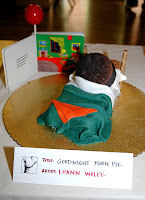
April 1st is the Edible Book Festival.
What is a better way to commemorate reading than with cake (or other fun food items)?
The Edible Book Festival is an annual festival celebrating books, and the people that love them. It's a global event which you can read more about on Books2Eat.

It's a fun idea, some local librarys hold events, and some homeschool families and their groups hold smaller versions.
There are many great entries which you can view online. Here are some of my favorites! Enjoy!

Little House in the Big Woods


The Girls Who Loved Wild Horses

Green Eggs and Ham


Goodnight Moon Pie


A Brief History of Thyme


Sherlock Scones


Finnegan's Cake
image

Scrabble Board Game


The Grapes of Wrath